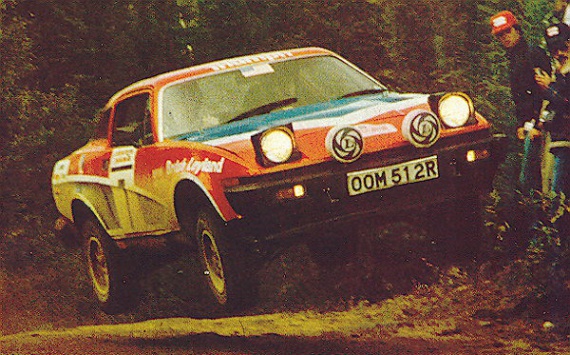

It is impossible to consider the progress of the TR7 without also looking at the career of Tony Pond, established as Britain's fastest rally driver of his time. Pond nurtured the TR7 through its early days, giving both the 16-valve version and the V8 version their first wins. In 1979, he left BL Motorsport under a slight cloud, but for 1980 he was back again. The new team was a happier team to work with and the results started to flow. Alongside Tony Pond, many of the car's best results have come from Per Eklund, the Swedish driver who joined the team in 1979 after leaving Saab. And, further afield, John Buffum used the TR7 V8 to dominate North American rallying over a number of years. Buffum won the SCCA Pro-Rally title four years in a row and was the 1980 North American champion.
From the outset it had been apparent that the TR7 was a better rally car on tarmac than it was in the forests. Chassis developments designed to help get over the problem were implemented and it was significant that Per Eklund's third place in the 1980 1000 Lakes Rally was his highest ever finish on that event. Tony Pond finished fourth on the Scottish in 1980 and second at the BPRally-sprint. Even before BL Motorsport announced that they were going to rally the l6-valve version of the TR7, there were rumours that a V8 version of the car was on the drawing board. So, when the car first appeared at the beginning of 1978. it was no real surprise. With the Rover engine lighter than the old Triumph unit, and considerably more powerful, it seemed that BL might have a winning car at last. In two years of rallying with 16-valve TR, results had been somewhat thin on the ground.
Tony Pond launched the TR7 V8's rallying career with a win first time out on the Granite City Rally in Scotland, a round of the Castrol/Eurosport National championship. Despite this encouraging debut, it was soon apparent that the suspension and chassis development which had been good enough for the less powerful car was certainly not suitable for a car now developing almost 270bhp.
The Rover V8 engine was the natural choice of power unit for the TR7 when the team were looking around for more power. Although some work had been done on the engine for racing in America (the block originally came from Buick) all the real development was still to be done. In its road going form, the V8 produced only 155bhp; now the rally engine was giving over 300bhp.
The first technical change to the engine was to replace the hydraulic tappets which were fitted to the road version. Although there was no problem with the hydraulic system, it did limit the revs that could be used and so restricted the power available from the engine. In fact, most of the V8 power came from fairly low down the rev range, with maximum torque at 5500rpm. and this was one of the problems which drivers had to overcome. To anybody used to the high revving, punchy Escort BDA unit, the Rover V8 was a lazy pushing engine. The power was there all the time.
With the top end of the engine sorted out, the team had the power and rev range that it needed and, although minor adjustments were made, engine development went quiet until mid-way through 1979. By then the team was moving away from short, sprint events towards longer World Championship rallies, and fuel consumption was becoming a problem. For the 1000 Lakes Rally in 1979, the team tried a Pierburg fuel injection system, and at the beginning of 1980 the engine was fitted with four Weber carburettors. This improved the power range still further, resulting in more torque and pushed fuel consumption down from 5-6mpg to 8-10mpg.
Two other isolated problems which arose earlier in 1980 also appeared to have been solved, the most worrying of which was in the dry sump system. Over long stages the oil pressure was dropping away; a redesign of the dry sump pan and the installation of a dual action scavenge pump solved the trouble.

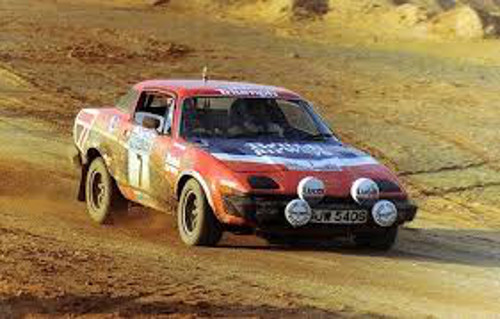
One of the most controversial aspects of the TR7 had always been the suspension geometry, and in particular the track. The TR7 had an exceptionally wide track compared with Escorts, Talbots and its other major rivals. On forestry rallies this proved to be a major disadvantage as the car was unable to follow the ruts or natural lines through corners, the track ahead of it being cut up by the preceding cars.
More than anything else, this problem led to Tony Pond leaving the team at the end of 1978 and, perhaps significantly, giving the car one of its best results just before he left; fourth overall on the RAC Rally. In July 1979 Richard Hurdwell was employed specifically to sort out the chassis problems and the TR7 was then a very sophisticated rally machine. On the Manx International, the team were able to alter the castor angle of the front wheels at a service point. This fine tuning of the suspension was made more crucial by the use of the 'new generation’ of rally tyres, radial racers. BL Motorsport experimented with Michelin tyres and, in testing, found an extra 3 secs per mile. In the days of intense competition, such an advantage was immense.
There was no doubt now that the TR7 V8 was very fast indeed, and this led to another technological advance - into the field of aerodynamics. For tarmac events the car is geared to just under 140mph, and reached over 125mph even in the forests. The 3.9:1 differential, although homologated was never used and would push the top speed even higher. At over 120mph in a forest, the TR7, indeed any rally car, took some controlling and the fact that the car started to lift off the track at that speed didn't help. The team had already spent some time working on the aerodynamics and further work to improve the stability would be the next step. Such technicalities as the aerodynamics, the driving position and the torque of the engine, all combined to make the TR7 a difficult car to drive and it was generally accepted that the only way to get good results with the TR7 V8 was to drive it hard. If there was one man who can do that, it was Tony Pond and it was no co-incidence that it was Pond who gave the car its best results.


Suspension:
Front: MacPherson strut with Bilstein damper unit.
Rear: solid axle located by four trailing links and one lateral arm, coil springs acting on lower arms, Bilstein dampers.
Brakes:
Lockheed discs all round, ventilated at front, solid at rear. 4-pot calipers at front, 2-pot calipers at rear. Variable balance no servo.
Effective braking area 58 sq in.
Gearbox:
Rover Triumph S-speed with internal oil pump. Ratios 2.33:1/1.611:1/1.30:1/1.00:1/0.833:1. Single plate Borg & Beck clutch.
Axle:
Live, solid tube, Rover Triumph unit fitted with Salisbury Power Lok differential. Alternative axle ratios 3.9:1 /4.5:1/4.8:1/5.3:1.
Dimensions:
Weight approx 1070 kg, overall length 4060mm, width 1680mm, height 1270mm. All steel body.
Fuel capacity 22 gallons, fuel consumption 8-10 mpg. Dry sump lubrication.
Homologated into Group 4: April 1, 1978, homologation no 654.
